Capital Gains Tax
Capital Gains Tax
What Is the Capital Gains Tax?
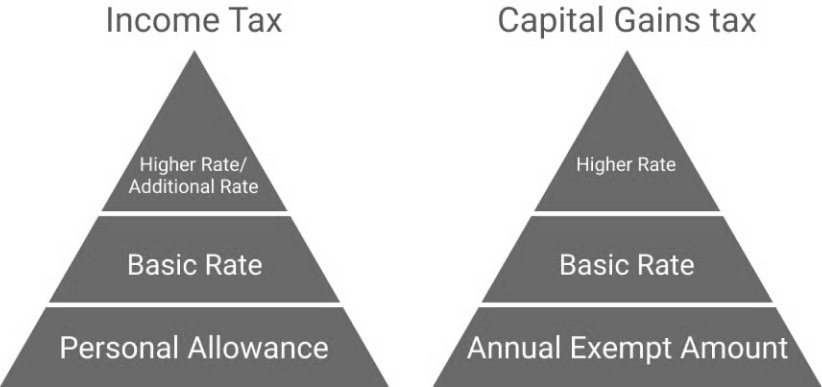
The capital gains tax is the levy on the profit from an investment that is incurred when the investment is sold. When stock shares or any other taxable investment assets are sold, capital gains, or profits, are referred to as having been “realized.” The tax doesn’t apply to unsold investments or “unrealized capital gains.” Stock shares will not incur taxes until they are sold, no matter how long the shares are held or how much they increase in value.Short-term capital gains tax applies to assets that are sold one year or less from the date they were purchased. This profit is taxed as ordinary income. For all but the wealthiest taxpayers, that is a higher tax rate than the capital gains rate.
Capital Gains Tax Strategies

The capital gains tax effectively reduces the overall return generated by the investment. But there is a legitimate way for some investors to reduce or even eliminate their net capital gains taxes for the year.The simplest of these strategies is to simply hold assets for more than a year before selling them. That’s wise because the tax you will pay on long-term capital gains is generally lower than it would be for short-term gains
Don’t Break the Wash-Sale Rule
Be mindful of selling stock shares at a loss to get a tax advantage and then turning around and buying the same investment again. If you do that in 30 days or less, you will run afoul of the IRS wash-sale rule against this sequence of transactions. Material capital gains of any kind are reported on a Schedule D form. Capital losses can be rolled forward to subsequent years to reduce any income in the future and lower the taxpayer’s tax burden.
Use Tax-Advantaged Retirement Plans
Among the many reasons to participate in a retirement plan like a 401(k)s or IRA is that your investments grow from year to year without being subject to capital gains tax. In other words, within a retirement plan, you can buy and sell without losing a cut to Uncle Sam every year. Most plans do not require participants to pay taxes on the funds until they are withdrawn from the plan. That said, withdrawals are taxed as ordinary income regardless of the underlying investment. The exception to this rule is the Roth IRA or Roth 401(k), for which income taxes are collected as the money is paid into the account, making qualified withdrawals tax-free.
Cash in After Retiring
As you approach retirement, consider waiting until you actually stop working to sell profitable assets. The capital gains tax bill might be reduced if your retirement income is lower. You may even be able to avoid having to pay capital gains tax at all. In short, be mindful of the impact of taking the tax hit when working rather than after you’re retired. Realizing the gain earlier might serve to bump you out of a low- or no-pay bracket and cause you to incur a tax bill on the gains.
Watch Your Holding Periods
Remember that an asset must be sold more than a year to the day after it was purchased in order for the sale to qualify for treatment as a long-term capital gain. If you are selling a security that was bought about a year ago, be sure to check the actual trade date of the purchase before you sell. You might be able to avoid its treatment as a short-term capital gain by waiting for only a few days. These timing maneuvers matter more with large trades than small ones, of course. The same applies if you are in a higher tax bracket rather than a lower one.
Pick Your Basis
Most investors use the first-in, first-out (FIFO) method to calculate the cost basis when acquiring and selling shares in the same company or mutual fund at different times. However, there are four other methods to choose from: last in, first out (LIFO), dollar value LIFO, average cost (only for mutual fund shares), and specific share identification. The best choice will depend on several factors, such as the basis price of shares or units that were purchased and the amount of gain that will be declared. You may need to consult a tax advisor for complex cases. Computing your cost basis can be a tricky proposition. If you use an online broker, your statements will be on its website. In any case, be sure you have accurate records in some form. Finding out when a security was purchased and at what price can be a nightmare if you have lost the original confirmation statement or other records from that time. This is especially troublesome if you need to determine exactly how much was gained or lost when selling a stock, so be sure to keep track of your statements. You’ll need those dates for the Schedule D form.
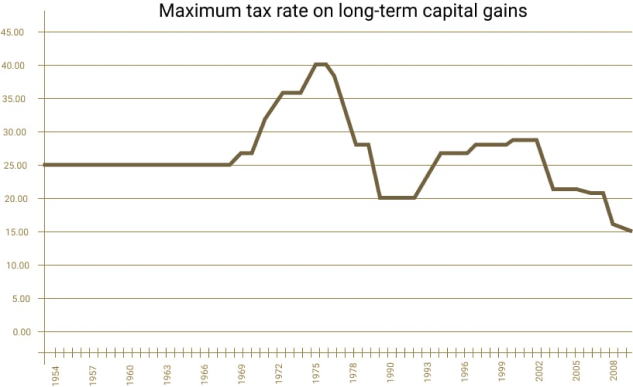
What Is Good About Reducing the Capital Gains Tax Rate?
Proponents of a low rate on capital gains argue that it is a great incentive to save money and invest it in stocks and bonds. That increased investment fuels growth in the economy. Businesses have the money to expand and innovate, creating more jobs.
They also point out that investors are using after-tax income to buy those assets. The money they use to buy stocks or bonds has already been taxed as ordinary income, and adding a capital gains tax is double taxation.
What Is Bad About Reducing the Capital Gains Tax Rate?
Opponents of a low rate on capital gains question the fairness of a lower tax on passive income than on earned income. Low taxes on stock gains shifts the tax burden onto working people. They also argue that a lower capital gains tax primarily benefits the tax sheltering industry. That is, instead of using their money to innovate, businesses park it in low-tax assets.