Antitrust law
Antitrust law
History of Antitrust
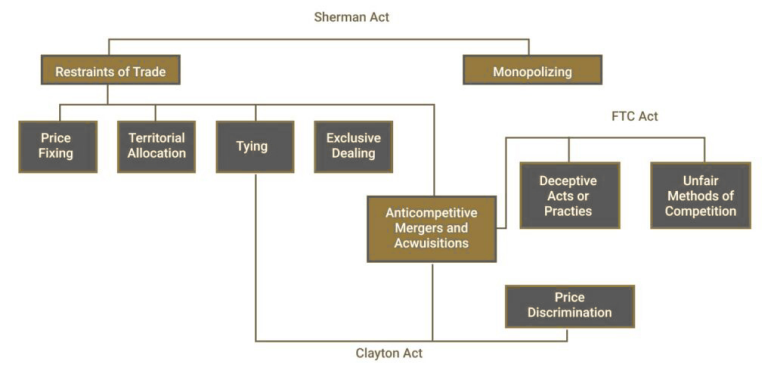
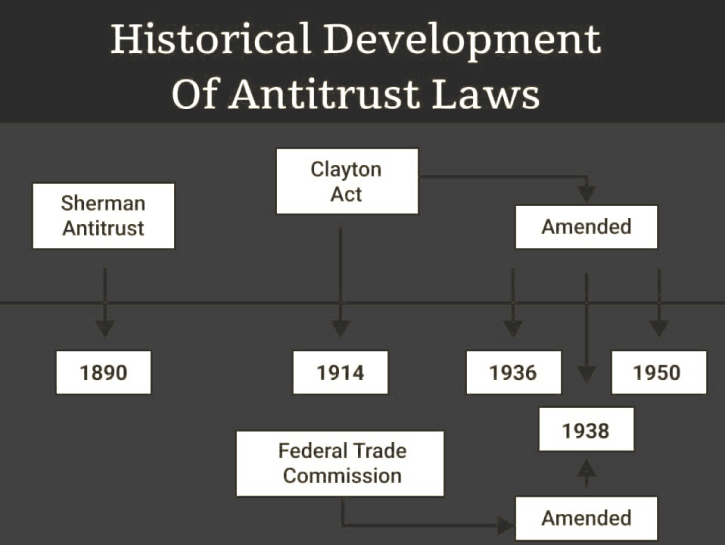
American antitrust law was formally created in 1890 with the U.S. Congress’s passage of the Sherman Antitrust Act. Using broad language “unequaled in its generality”, the Sherman Act outlawed “monopolize” and “every contract, combination … or conspiracy in restraint of trade”.
Every contract, combination in the form of trust or otherwise, or conspiracy, in restraint of trade or commerce among the several States, or with foreign nations, is declared to be illegal. Every person who shall make any contract or engage in any combination or conspiracy hereby declared to be illegal shall be deemed guilty of a felony ….
Sherman Act, section 1
Every person who shall monopolize, or attempt to monopolize, or combine or conspire with any other person or persons, to monopolize any part of the trade or commerce among the several States, or with foreign nations, shall be deemed guilty of a felony ….
Sherman Act, section 2
Courts quickly began struggling with the Sherman Act’s broad and vague language, recognizing that interpreting it literally might make even simple business entities like partnerships illegal. Federal judges began trying to develop legal principles for distinguishing between “naked” trade restraints between rivals that suppressed competition and other restraints that were only “ancillary” to other cooperation agreements that promoted competition.
What Do the Antitrust Laws Do for the Consumer?

Antitrust laws protect competition. Free and open competition benefits consumers by ensuring lower prices and new and better products. In a freely competitive market, each competing business generally will try to attract consumers by cutting its prices and increasing the quality of its products or services. Competition and the profit opportunities it brings also stimulate businesses to find new, innovative, and more efficient methods of production. Consumers benefit from competition through lower prices and better products and services. Companies that fail to understand or react to consumer needs may soon find themselves losing out in the competitive battle. When competitors agree to fix prices, rig bids, or allocate (divide up) customers, consumers lose the benefits of competition. The prices that result when competitors agree in these ways are artificially high; such prices do not accurately reflect cost and therefore, distort the allocation of society’s resources. The result is a loss not only to U.S. consumers and taxpayers but also to the U.S. economy. When the competitive system is operating effectively, there is no need for government intrusion. The law recognizes that certain arrangements between firms—such as competitors cooperating to perform joint research and development projects—may benefit consumers by allowing the firms that have reached the agreement to compete more effectively against other firms. The law does not condemn all agreements between companies, only those that threaten to raise prices for consumers or deprive them of new and better products. But when competing firms get together to fix prices, rig bids, divide business between them, or make other anticompetitive arrangements that provide no benefits to consumers, the Government will act promptly to protect the interests of American consumers.
The true purpose of antitrust law
The antitrust laws are supposed to promote and protect competition, or, if you will, competitive processes in distinct “lines of commerce” or “relevant markets.” This alone is their proper purpose. They are not intended to punish big companies merely on account of their size or because of their commercial success. Most importantly, antitrust laws have never been anti-market or anti-business in their underlying conception or in their implementation. On the contrary, the antitrust laws are intended to promote market economics and healthy competition in every market, while checking the abuses that sometimes arise in different markets.
The idea behind these laws is that in every market there should be robust competition: If in each market there are many sellers busily competing against one another to sell a particular kind of product or service to paying customers, no seller will be able to take unfair advantage of the buyers, but rather each seller will be obliged to offer its goods or service on attractive terms, and each will be responsive and efficient in its dealings with buyers, who otherwise will simply turn to another, better seller.
In other words, vigorous competition in any given market keeps sellers honest, forcing them to strive continually both to improve their goods and services and to offer them on favorable terms. Customers benefit from this competition. Poorly run companies are running out of business, as they deserve to be. The better run companies, and the most honest ones too, tend to prosper. Society as a whole benefit.
This is nothing other than marketplace economics working properly and rewarding each of us for our efforts, our talent, and our perseverance. Antitrust laws exist to help marketplace economics work better.
What do antitrust laws try to accomplish?
Antitrust laws, properly understood, are intended to grapple with this market contradiction. In particular they forbid any improper monopoly or any attempt to obtain a monopoly by improper means — that is, a monopoly obtained, preserved or attempted by a firm that on purpose has destroyed or tried to destroy its competitors, using anti-competitive tactics whose sole or true purpose has been to undermine rival businesses. The antitrust laws also forbid dominant firms to act in collusion in order to impose unfair commercial practices that tend to subvert “competition on the merits” in any market that they dominate or aim to dominate by means of the improper practice. These laws also outlaw specific kinds of recognized commercial fraud that by their very nature are calculated to destroy competition in the market in which they are employed (the most notable offenders are bid-rigging, price-fixing, and horizontal market allocation).
The Importance of Antitrust in Digital Economy
The latter relates to privacy. Privacy is not necessarily in and of itself important to competition regulators, but data is. Data can act as a barrier to entry, but can also be used to foreclose competitors’ access to markets and leverage market power from one market to abuse such market power in another market.
These issues go straight to the core of antitrust. It is extremely important to understand how data is collected, how it is used and combined, and how it is it monitored. Data gives firms a competitive advantage in almost all markets.
Many of the big tech platforms operate with “take it or leave it” terms and conditions, which allow them to collect both first party data and third-party data. A combination of first- and third-party data can be used to create super-profiles on users and monitor users online. What is abusive is not the combination of data per se, but imposing data collection and combination preconditions on users seeking to access the service of a given platform. This not only violates users’ fundamental human rights in terms their privacy, but, in circumstances where the platform holds a dominant position, it is also an antitrust violation in the form of a non-price exploitation and exclusion.
Due to serious under enforcement by privacy and data protection regulators, as well as by antitrust enforcers, certain tech companies have been allowed to develop into monopolies.
The ongoing global debate on antitrust law can hopefully ensure that the pendulum swings to the right level of enforcement – which can only be more than it is now where there is regulatory stagnation. This, however, requires antitrust enforcers and data protection authorities to co-operate to reign in tech companies